From electrical energy to renewable sources in Colombia
Colombia’s electricity generation matrix is one of the cleanest in the world due to the predominance of hydroelectric power as the main source of generation, through reservoirs.
This has enabled the electricity grid to maintain a low greenhouse gas (GHG) factor compared to the United States, the European Union, and China, where fossil fuels predominate.
In the Paris Agreement, Colombia committed to “reducing 20% of its emissions based on a projected scenario for 2030 and even reducing 30% if it receives international cooperation,” according to the Colombian Ministry of Environment.
In line with this, the country is focused on diversifying its energy matrix and transitioning to cleaner energies, especially in polluting sectors such as transportation and industry, where production from fossil fuels generates environmental impacts.
Progress has been made in recent years, although the share of solar and wind energy sources is lower, as shown in the following graph.
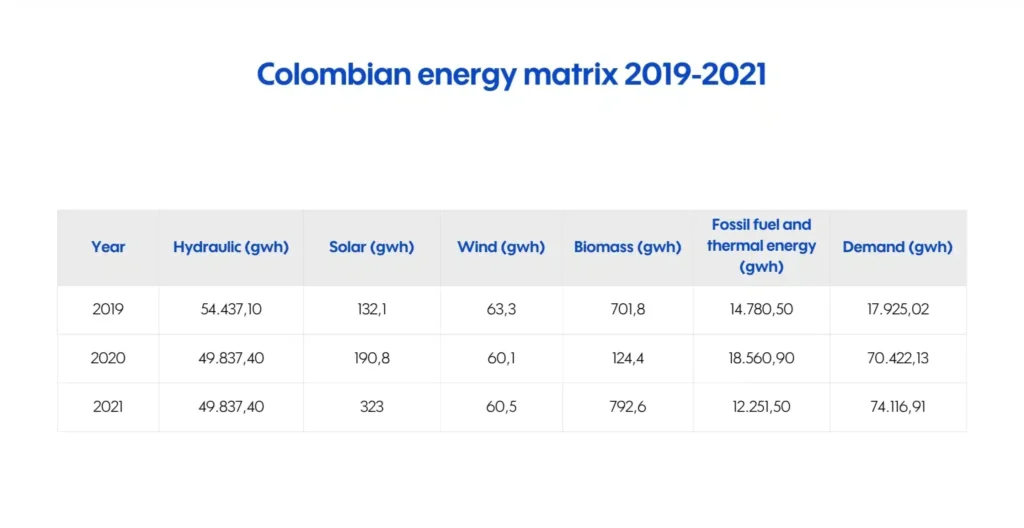
By 2021, there was a 21.50% increase in electricity generation from renewable sources and a 33.94% decrease in generation from non-renewable sources compared to the previous year.

Graphic source: Sustainable mobility in developing countries: multimodal and intelligent transport technologies and strategies / Ricardo Mejía Gutiérrez, academic editor. National University of Colombia.
Why is electrical energy so important in our lives?
What would our lives be like without electrical energy? When we flip a switch in our homes, the electrical circuit closes to connect one point to another. Charged particles or electrons move between these points when there is a difference in power between them. This generates an electric current and then light.
This circuit, made up of a network of wires, is designed to carry electrical current from the power source, which may be the public grid or a private company.
On the other hand, electrical power systems are responsible for three fundamental components: generation, transmission, and distribution. Around the world, these systems are experiencing a strong penetration of renewable energy.
Thus, since the beginning of the century, efforts have been made to close fossil fuel power plants, such as coal-fired plants, and replace them with natural gas plants due to their low GHG impact and public health concerns.
One of the challenges facing hydroelectric power generation is climate change and the effects of the El Niño phenomenon (a period of intense summer heat), which significantly reduces the water reserves available in reservoirs.
In fact, in January 2024, Acolgen warned of this decrease in reserves (from 73% in December to 57% in January this year) and the possibility of energy rationing in several areas of Colombia.
These cuts, even if scheduled, affect the supply and quality of energy in homes and businesses.
How do non-conventional renewable energies work?
According to the book Sustainable Mobility in Developing Countries: Multimodal and Intelligent Transport Technologies and Strategies, each type is described as follows.
- Hydroelectric energy: in reservoirs, water flows at a lower level than the generators and is transformed into kinetic energy and then into electrical energy.
- Solar energy: obtained by capturing the light and heat emitted by the sun, thanks to the photovoltaic effect that converts light into electricity.
- This process occurs through semiconductor materials that have the property of absorbing photons and generating low resistance to allow the flow of current.
- Wind energy: this is the energy available in wind currents. Large generators, either horizontal or vertical, are used to convert wind energy into electrical energy.
What solar energy projects does Colombia have for 2024?
According to the newspaper El Colombiano, 66 renewable energy projects are expected to come online in 2024. Of these, 22 are solar projects. All of this would add 3,040 megawatts (MW) of new capacity to the energy matrix.
If these projects overcome financial viability obstacles and obtain permits and are successfully implemented, this capacity could light up a city like Bogotá, with more than 11.6 million inhabitants.
The potential of renewable energy is enormous. According to data from the Worldmeter website, only 15% of the solar energy that reaches the earth is used by the planet’s inhabitants. And if oil reserves come to an end (it is estimated that there are 39 years left), this resource will be a possible alternative for continuing to generate reliable, high-quality energy.
With this scenario unfolding in Colombia and other countries in the region, it is important to understand the importance of a quality electricity supply. Scheduled and unscheduled power outages impact the proper functioning of equipment and investment in infrastructure, so proactive action is key.

Contact Us
Questions or comments? Please contact us: