When should you choose an automatic voltage regulator?
Maintaining a regulated voltage is one of the concerns in homes and industries. Devices that fulfill this promise are used for this purpose, but when is an Automatic Voltage Regulator (AVR) used and how does it differ from a conventional one?
What are automatic voltage regulators?
As their name suggests, voltage regulators or stabilizers maintain a stable output voltage despite fluctuations in the input voltage. This prevents the performance and service life of electrical equipment from being affected.
The main feature of Automatic Voltage Regulators (AVRs) is that they include an automatic control mode to monitor and adjust the output voltage without human intervention.
In other words, they do not need to be configured manually because they are designed to detect any variation above or below the set range. This allows them to operate with greater precision.
On the other hand, automatic voltage regulators differ from conventional regulators because they have an internal transformer that varies according to the design and specifications of each device.
How do automatic voltage regulators work?
Industronic AVR regulators are characterized by regulating line-to-line and line-to-neutral voltage levels. What does this mean?
In the first case (between lines), the regulator maintains a regulated voltage between the phases of the electrical network. In other words, the voltage difference must be stable and close to the nominal value (220 volts in a three-phase system).
This is achieved through constant monitoring of the voltage between lines and automatic adjustment, which protects sensitive electronic equipment such as computers, motors, and appliances.
In the second case, line to neutral, fluctuations are compensated by maintaining a regulated voltage between each phase and the neutral of the electrical network. Thus, the voltage of each phase will be stable and close to the nominal value (for example, 110 V in a single-phase system).
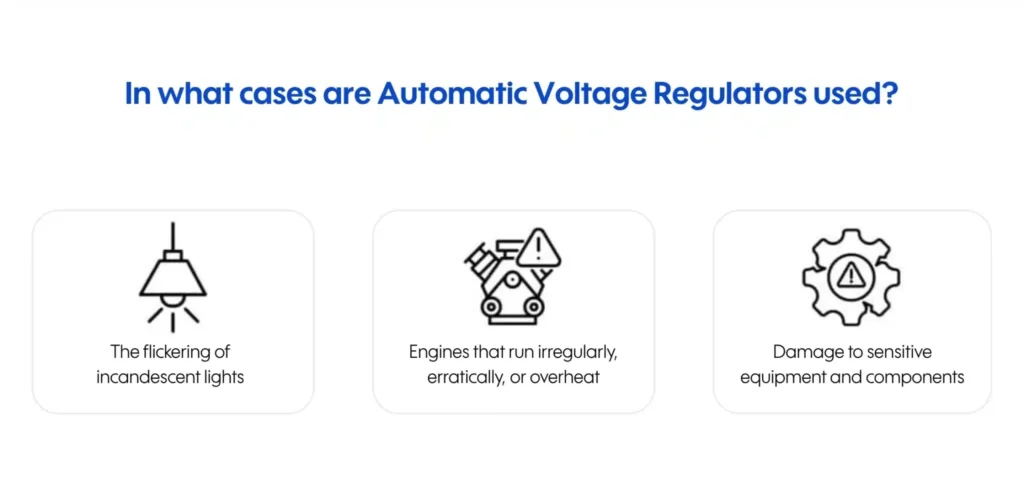
In what cases are automatic voltage regulators used?
Some signs of situations that arise in industries and that suggest implementing this AVR option are:
- The flickering of incandescent lights is related to voltage fluctuations between lines.
- Motors that run irregularly, erratically, or overheat when there are line-to-neutral voltage fluctuations.
- Damage to sensitive equipment and components due to voltage surges or drops.
With this model, regulators help companies and industries maintain uninterrupted power supply and, as they are automatic, they minimize the management of this task.
In fact, they have a function to ensure continuity of operation even during maintenance.
What are the applications of automatic voltage regulators?
As precise devices that do not require manual management, automatic voltage regulators are ideal for protecting sensitive electronic equipment such as respirators, patient monitors, and diagnostic imaging machines.
They are also essential in rural residential areas to maintain a regulated and safe power supply, protecting appliances and electronic equipment from voltage fluctuations common in these regions.
In the industrial sector, they stabilize power for machinery, lighting, surveillance cameras, and alarms, ensuring operational safety.
In addition, they are also indispensable for computers, servers, networks, and industrial control systems that have key cards and components.
In the commercial sector, AVRs protect payment systems, point-of-sale terminals, and security equipment. In the agricultural sector, they ensure the operation of irrigation and climate control equipment.
Finally, in telecommunications, they maintain the stability of networks and transmission systems, while in video, audio, and lighting applications, they protect projectors, sound systems, and lights from electrical fluctuations.
In conclusion, having an AVR provides greater convenience in protecting costly equipment investments and reducing component malfunctions.
They are essential for a more stable and secure power grid for the equipment connected to it.

Contact Us
Questions or comments? Please contact us: