When should I buy a voltage stabilizer? This is one of the questions homeowners ask themselves when they live in an area or region where the power grid is unstable. However, you shouldn’t wait until your appliances are partially or totally damaged and you lose your investment in your home: it’s always time to protect them. What’s the best way to do this? With a voltage stabilizer, also known as a voltage regulator. Here’s how it works and what you need to know before buying one.
First, remember that there is an average stable voltage that represents the amount of energy delivered by the source on a consistent basis. It is calculated using a voltmeter to measure the instantaneous values of the voltage over a given period of time.
In an ideal electrical system, the voltage should be perfectly stable, but in practice it fluctuates, which is one of the most common problems in areas where a stable service is not guaranteed. How do these changes occur and why do they damage equipment in the home?
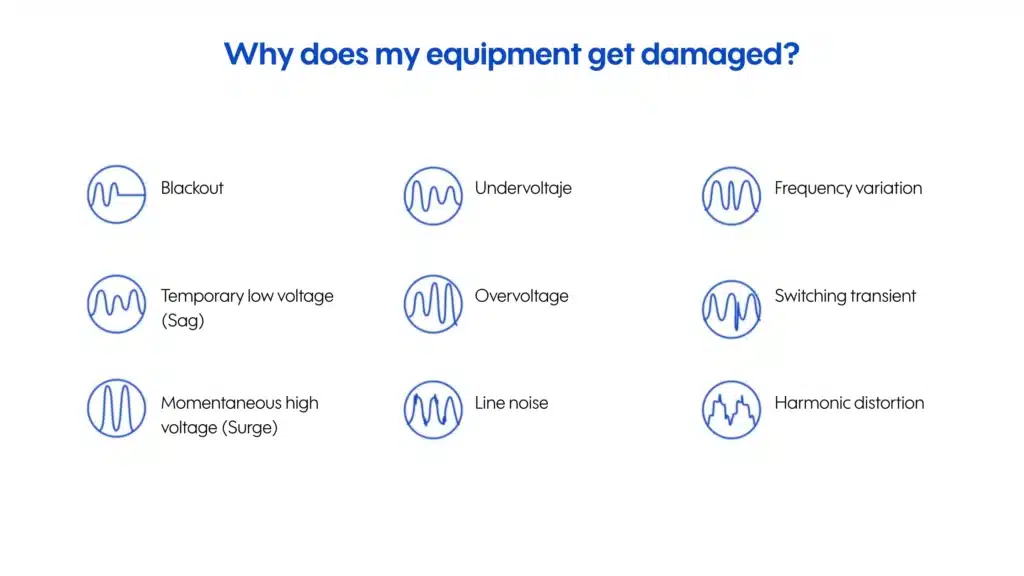
One of the most common conditions is called a voltage spike (momentary high voltage or surge), which occurs as a sudden, short-lived increase in voltage that can last from microseconds to milliseconds. Similarly, a voltage dip (momentary low voltage or sag) can occur.
The most frequent causes of these two situations are atmospheric discharges or lightning; there are also power grid failures that can cause short circuits, damage to equipment, or interruptions and outages in the power supply.
However, when it is not temporary or momentary, but rather prolonged, other conditions occur, such as sustained overvoltage, which lasts from a few seconds to several hours and has a significant impact on electrical equipment and can even cause fires. When it falls below the expected nominal level, sustained undervoltage occurs. In both cases, the useful life of the equipment is reduced or its performance is impaired.
Other conditions include line noise, which is considered to be unwanted disturbance of an electrical signal and occurs due to natural causes such as solar activity and atmospheric discharges, among other phenomena. It can also be caused by poor grounding, among other things.
Last but not least, harmonic distortion should not be ruled out. When continuous and significant, it causes overheating and cable and equipment failures, loss of efficiency in motors and transformers, and interruptions in communication and signal systems.
For all these situations, it is important to consider a simple and accessible solution such as a voltage stabilizer or regulator.
How does a voltage stabilizer work?
A stabilizer has sensors that measure the input voltage from the power company. This information is sent continuously to a control circuit, and after analysis, the output voltage is determined. This is adjusted to ensure the ultimate goal of maintaining stable voltage.
“Although they are slower (than an uninterruptible power supply or UPS) and the amount of power they can regulate is smaller,” explains engineer Eduardo Abraham of Industronic, they are very useful in the home for equipment that is not mission-critical, such as household appliances, and which, if they stop working, do not interrupt sensitive processes.
What should I consider when buying a voltage stabilizer?
- Assess your power requirements. It is important to know the total wattage of all the equipment that will be connected to a regulator.
- Check the capacity of the regulator. They are available with capacities ranging from 100 to 135 W. It is important to leave a safety margin to avoid oversizing the final result.
- Know the type of electrical network. The distribution of power from the utility company to your home can be done through single-phase networks, while three-phase networks are more common in industries.
- Define the working voltage. If you are choosing separately for a particular piece of equipment, then you need to know the voltage specified for that equipment on the back or on the nameplate. Apply a multiplication formula to the current consumption to find out the total you need to protect.
- For example, a refrigerator consumes 780 watts, which is the result of multiplying the consumption by the voltage. With this information, you can ask for the right equipment.
What care should you take with the voltage stabilizer?
Although they come in different sizes, it is important to check the space where they will operate. It is necessary to study the dimensions and locate it in the best way to protect it. Annual maintenance is recommended to calibrate it and check that there is no accumulation of dust or contaminants, thus prolonging its useful life.
Are they safe to use at home?
Absolutely. As their name suggests, they are devices designed to stabilize voltage. They add a layer of security and safeguard the investment you have made in your home by purchasing, in some cases, expensive equipment such as televisions, refrigerators, or computers. They also save you headaches with unnecessary repairs due to malfunctions or problems such as continuous reboots or misconfigurations that require you to call a technician.
How do I know if I need a regulator or a UPS?
“It will depend on the type of load and the process, whether it is critical or not,” says Héctor Mondragón, an engineer with Grupo Industronic. He explains that in areas where the power supplier is poor, with frequent outages and damage to machinery, combined solutions are possible. For example, use a regulator or stabilizer for services such as air conditioning, a compressor, or an elevator. In this case, “the duration of the power outage will not impact them,” he adds.
On the other hand, other types of sensitive or electronic equipment, or a critical or essential business process, cannot have interruptions or may be damaged by a sudden change in voltage. In this case, it is important to stabilize the voltage but, more importantly, to avoid economic losses due to power outages, which can range from damage to components such as cards to failures in the delivery of products to the end customer.
UPSs require annual maintenance, but unlike regulators, they do not need to be calibrated.
Purchasing a voltage stabilizer or regulator is not an unnecessary expense; on the contrary, it is an investment to protect your home appliances. The best way to choose the right one is to determine the capacity in terms of power, and to do this, Grupo Industronic has a line of regulators to suit your needs.